Why Recovery Sandals Are the Wrong Shoe on Stairs
Quick Answer: Recovery sandals work by putting a thick, compliant foam layer between your foot and the ground. That same layer removes the ground feedback and edge definition you need on stairs, raises your foot 3 to 5cm off the floor, and lets the sole compress unevenly on a step edge. Combined with an open heel, this is the least stable footwear situation in your house. Take them off for stairs, or choose a backed pair if you use stairs frequently.
They are the best thing you own after a long run.
They are also, statistically, one of the more precarious things you can be wearing on a staircase — and most people never make the connection because nothing has gone wrong yet.
It is not a design flaw. It is the design working exactly as intended, applied to the one surface it does not suit.

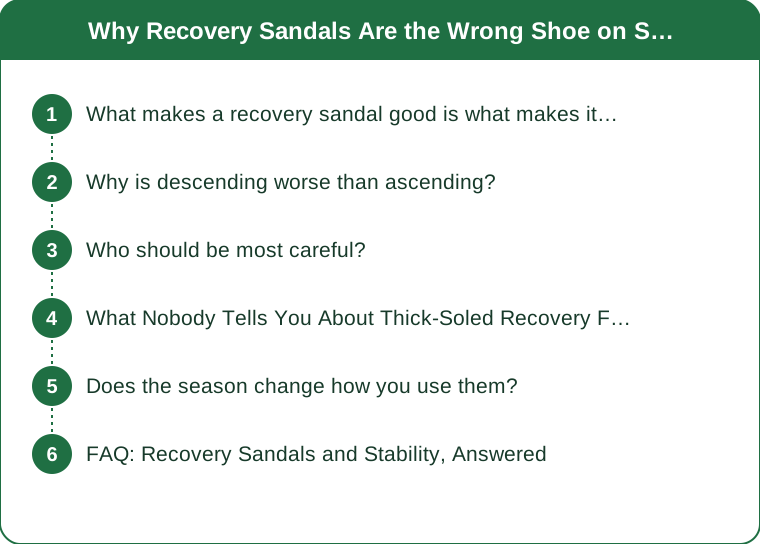
What makes a recovery sandal good is what makes it bad here
The whole proposition is a thick layer of soft foam that absorbs impact and reduces pressure on tired feet.
Three consequences follow, and all three are helpful on flat ground and unhelpful on stairs:
Proprioceptive damping. Thick soft foam reduces the sensory information your foot receives about the surface. On a flat floor you do not need that information. On a stair edge you need it precisely.
Increased stack height. Most recovery sandals raise the foot 3 to 5cm off the ground. Higher centre of mass means a longer lever for any lateral wobble, and it changes your effective step height on every single stair.
Compliant edge behaviour. When you place a foot partly on a stair nose, a firm sole either supports the load or does not. A soft foam sole compresses on the loaded side and rolls, which produces a small unexpected rotation at exactly the wrong moment.
Add an open heel — no retention at the back of the foot — and you have removed the last thing keeping the shoe attached during the swing phase of a descending step.
Why is descending worse than ascending?
Because descending is a controlled fall and it demands precision at the toe.
Going up stairs, you place the whole forefoot on the tread and push. The foot is loaded centrally, the sandal is fully supported, and if the shoe slips you are moving toward the stairs, not away from them.
Going down, three things change:
- You land on the forefoot near the step edge, often with the rear of the foot over open air. A soft sole overhanging an edge compresses asymmetrically.
- You need accurate height perception. Extra stack height means your foot arrives sooner than your nervous system predicts, which is the classic mechanism behind a missed step.
- The open heel lets the sandal lag. During the swing phase, an unsecured sandal can rotate or slide slightly on the foot, so it lands at an angle you did not choose.
The specific failure mode most people experience is a heel catching the step above while descending, or the sandal sliding forward off the toes on a steep flight.
Who should be most careful?
Anyone whose balance system is already working harder than usual.
People who are genuinely fatigued. The exact moment you reach for recovery sandals — after a long run or a long shift — is when your balance and proprioception are most degraded. That is an unfortunate overlap.
Anyone carrying something. Laundry, a child, a mug. Occupied hands mean no handrail, and hands provide a lot of stability on stairs.
Older adults. Falls on stairs are a serious injury mechanism, and both open-backed and thick-soled footwear are consistently identified as poor choices for stair use.
Anyone with a recent lower limb injury. Reduced ankle proprioception plus damped feedback is a compounding problem.
People on carpeted stairs. Carpet plus foam is two compliant layers, which further blurs edge definition.

What Nobody Tells You About Thick-Soled Recovery Footwear
They change your gait everywhere, not just on stairs. Thick soft soles alter ankle strategy — you rely more on hip control and less on the fine ankle adjustments that normally handle small perturbations. Wear them all day and that becomes your default pattern.
Foam gets softer with wear before it looks worn. A pair that felt supportive last spring may be substantially more compliant now, with no visible change. That means stability degrades invisibly over months.
Wet foam is worse. Some recovery foams become noticeably more slippery when wet, and bathroom stairs or a wet doorstep are exactly where this shows up.
A backed version solves most of it. Recovery slides with a heel strap, or recovery clogs with a back, keep the shoe attached to the foot. The damping remains, but the retention problem is gone.
Socks make it worse, not better. A sock inside a smooth-footbed sandal removes friction between foot and shoe, which is the opposite of what you want on a staircase.
Does the season change how you use them?
It does, and autumn is when household stair use with sandals rises.
Indoor time increases. As the weather turns, more of your day happens inside, which means more trips up and down stairs in whatever is on your feet.
Socks come out. The autumn habit of wearing socks with recovery sandals is common, comfortable, and takes away the foot-to-footbed grip that was holding things together.
Feet are colder and less sensitive. Cold reduces tactile sensitivity in the feet, adding to the proprioceptive damping the sandal already provides.
Foam is firmer in the cold. Most EVA and similar foams stiffen at lower temperatures. This actually improves edge behaviour slightly, but changes the feel from what you are used to — which is its own adjustment.
The practical seasonal move: if your recovery sandals have become indoor house shoes for the winter, switch to a backed pair or a proper supportive slipper for the months where you use stairs twenty times a day.
FAQ: Recovery Sandals and Stability, Answered
Are recovery sandals bad for you generally?
No — used as intended, for a limited period after training, they are genuinely useful. The problems come from all-day wear, which changes gait, and from using them on stairs and uneven ground.
How long should I actually wear them?
Most of the benefit comes in the first 30 to 60 minutes after training. Beyond a couple of hours, the case gets weaker and the gait-alteration case gets stronger.
What should I wear on stairs instead?
Anything with a heel retention and a firmer, thinner sole — a trainer, a backed slipper, or bare feet if the stairs are not slippery. Bare feet give the best proprioception of all.
This is general information, not medical advice. If you have had a fall, balance problems, or any neurological condition affecting sensation in your feet, get individual footwear advice.
TL;DR:
- The thick, soft sole that makes recovery sandals effective also removes edge feedback, raises your foot 3 to 5cm, and compresses unevenly on a step nose.
- Descending is the risky direction — forefoot landings near an edge, misjudged height, and an open heel that lets the shoe lag.
- Highest risk is when you are fatigued, carrying something, or on carpeted stairs — which is most of the time you actually wear them.
- Autumn brings indoor stair use and socks-with-sandals, both of which make it worse; a backed pair fixes most of it.
Keep them for the twenty minutes after training when they earn their keep. The staircase is not where they belong.
Keep Reading
This article is for general informational and styling purposes only. Fit, sizing, and product availability may vary.