Why Recovery Sandals Are Not Walking Shoes
Quick Answer: Recovery sandals are built for low-mileage standing and short walks after exercise — soft, high-stack midsoles with a contoured footbed and minimal heel retention. That design maximizes immediate comfort and minimizes support for repetitive gait. Past roughly a mile, your foot has to grip to keep the sandal on, which fatigues the small muscles you were trying to rest. Use them for the walk to the car, not for the day out.
You bought them because the first time you put them on after a long run it felt like relief in physical form. Then you wore them around a city for an afternoon and your arches ached in a way running never causes.
The sandal did exactly what it was designed to do. It was simply doing it for four hours instead of twenty minutes.
Here is where the line is and how to stay on the right side of it.

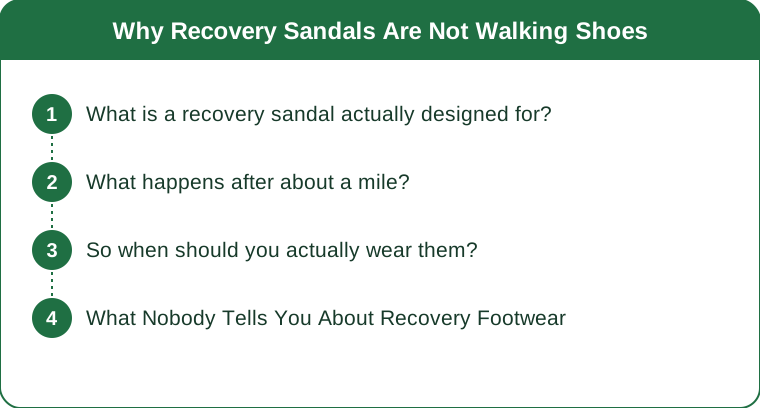
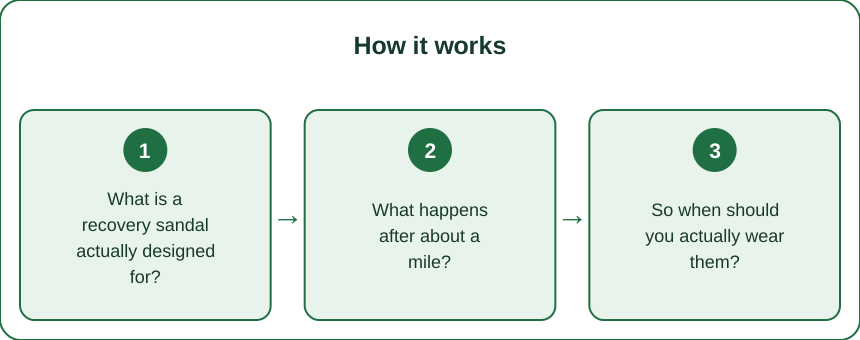
What is a recovery sandal actually designed for?
Short-duration unloading immediately after exercise. That is a narrow specification and they meet it very well.
Soft, thick midsoles reduce peak pressure. Sitting or standing after a hard session, that softness reduces the load on tender tissue and simply feels good. This is the primary function and it is genuine.
A contoured footbed provides passive support. The molded arch shape supports the foot without any muscular effort, which is restful for a short period.
Minimal retention is a feature, not an oversight. They are meant to be slipped on and off with tired legs, so nothing holds your heel. The consequence is that walking any real distance requires your toes to grip to keep them on — and that is the whole problem.
They are not shock absorbers for gait. Very soft, unstructured foam compresses and destabilizes under repeated heel strike. A running or walking shoe uses firmer, structured foam precisely because it has to manage thousands of impacts.
What happens after about a mile?
Your intrinsic foot muscles start doing the work of the missing strap.
Toe gripping fatigues the small foot muscles. Curling your toes to retain a loose sandal engages the flexors continuously. Those are exactly the muscles you were hoping to give a break, and they tire quickly.
Gait changes to compensate. People shorten their stride and shuffle slightly in loose sandals, which alters loading through the calf and Achilles. Over an afternoon, that is a novel stress your body has not trained for.
The soft foam destabilizes. Every step compresses the midsole unevenly, so your ankle makes a small correction each time. Thousands of small corrections is real work.
Then the arch aches. The very common complaint — great for twenty minutes, arches sore by the third mile — is the predictable end point of all three effects combined.

So when should you actually wear them?
Immediately after exercise, for short distances, and around the house. That is the whole use case and it is a valuable one.
The walk from the workout to the car or the shower. This is the sweet spot. Ten minutes of soft, easy unloading when your feet are most sensitive.
Standing around post-race or post-class. Excellent. Standing does not require retention or repeated impact.
Around the house in the evening. Fine, and considerably better than bare feet on a hard floor if your feet are sore.
Not for the day out, the airport, the market, or the city walk. Those are walking-shoe jobs. If you are going to cover more than a mile, wear something with a fastened heel and a structured midsole — and take the sandals in the bag for afterward.
Also not for hard training or lawn work. Loose footwear plus lateral movement or dropped objects is a straightforward injury risk.
What Nobody Tells You About Recovery Footwear
A backstrap changes everything. The same brand’s slide and its backstrap sandal are functionally different products. If you want one pair that can also handle a couple of miles, buy the version with a heel strap — it removes the toe-gripping problem almost entirely.
They lose their function long before they look worn. Soft foam compresses permanently. A pair that has been worn daily for a year is often providing far less cushioning than it appears to, and people keep wearing them wondering why the relief stopped.
Foot strength matters more than the sandal. If your feet ache after any modest walk regardless of footwear, the answer is progressive foot and calf strengthening, not softer shoes. Cushioning treats the sensation; strength addresses the cause.
Do not wear them for the drive. Loose footwear on pedals is genuinely unsafe. This gets ignored constantly because they are so convenient after a session.
They are not a treatment for plantar fasciitis. They can reduce symptoms in the short term, which is useful, but they do not address the loading problem underneath it and can delay people from getting real help.
This is general information, not medical advice. Persistent heel or arch pain lasting more than a few weeks is worth having assessed.
TL;DR:
- Recovery sandals are designed for short-duration unloading right after exercise, not for repeated gait.
- Minimal heel retention means your toes grip to keep them on, which fatigues the exact muscles you wanted to rest.
- Soft unstructured foam destabilizes under repeated heel strike, adding thousands of small ankle corrections.
- Use them for the walk to the car, standing around after a session, and around the house.
- For anything over a mile, wear a fastened, structured shoe and carry the sandals for afterward.
- Buy the backstrap version if you want one pair to do both, replace them before they look worn, and never drive in them.
They are a genuinely good product for a genuinely narrow job. Keep them in that job and they stay the best twenty minutes of your post-workout routine instead of the reason your arches hurt on a Saturday.
Keep Reading
This article is for general informational and styling purposes only. Fit, sizing, and product availability may vary.