Why Recovery Sandals Feel Amazing for 20 Minutes and Then Your Feet Start to Ache
Quick Answer: Recovery sandals are built with a firm, deep heel cup and pronounced arch support designed for brief, post-activity wear — that same structure feels supportive for the first 15-20 minutes but can start pressing uncomfortably into feet with extended, all-day wear, because they weren’t engineered for the same continuous-support demands as everyday footwear.
The discomfort that shows up an hour in isn’t a sign of a defective sandal — it’s a sign the sandal is being used outside its intended window.

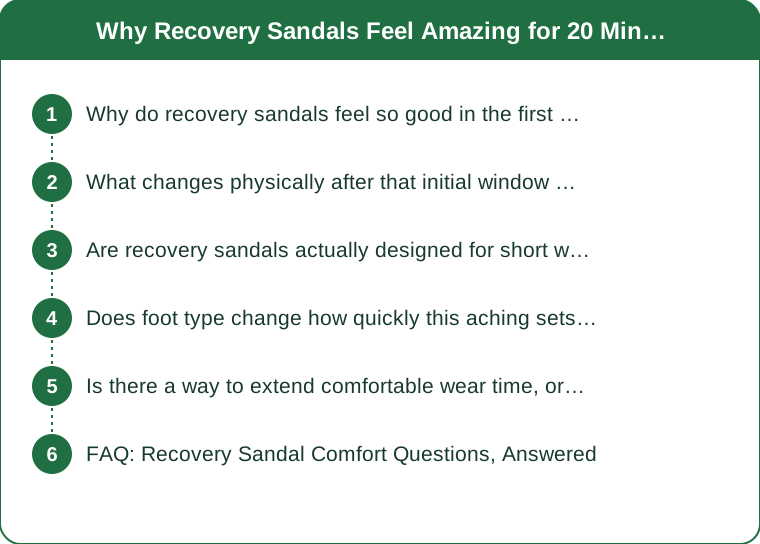
Why do recovery sandals feel so good in the first 15-20 minutes?
Their deep, contoured heel cup and pronounced arch support immediately cradle a foot that’s often mildly swollen or fatigued from a workout, providing a level of structured cushioning and support that feels noticeably better than a flat shoe or barefoot walking right after activity — that initial contrast is a big part of why the first stretch of wear feels so good.
What changes physically after that initial window that causes aching?
The same firm arch support that felt good initially applies sustained, concentrated pressure to a specific area of the arch over time, and feet that aren’t used to that continuous pressure point can start to feel it as discomfort or mild ache once the initial post-workout swelling reduces and the foot’s natural shape reasserts itself against the molded support.
Are recovery sandals actually designed for short wear, or is this a flaw?
They’re generally designed for short-to-moderate wear windows — post-workout recovery time, walking around a house or gym, brief errands — rather than as an all-day everyday shoe replacement, so the aching with extended wear reflects a mismatch between use case and design intent rather than a manufacturing flaw.

Does foot type change how quickly this aching sets in?
Yes, noticeably — people with flatter feet or less naturally pronounced arches often adjust to the support faster and comfortably, while people with high arches or feet unaccustomed to structured support can feel the pressure point sooner, sometimes within the first hour rather than several hours in.
Is there a way to extend comfortable wear time, or should duration just be limited?
Breaking in a new pair gradually over the first couple weeks (starting with 20-30 minute wear windows and slowly extending) helps feet adapt to the support pattern, but even well broken-in recovery sandals are generally still better suited to a few hours of wear at most rather than being worn as a full-day, everyday shoe.
FAQ: Recovery Sandal Comfort Questions, Answered
Is it normal for recovery sandals to feel different on different days?
Yes — foot swelling, activity level, and even hydration can change how the same support structure feels day to day, so some daily variation in comfort is expected rather than a sign something’s wrong.
Should recovery sandals be sized differently than regular shoes?
Often yes — many brands recommend true-to-size or even slightly larger sizing to accommodate mild post-workout foot swelling comfortably within the molded footbed shape.
Is aching after extended wear a sign to size up or down?
Not necessarily a sizing issue — it’s more often simply a duration issue, so trying a shorter wear window before assuming the size is wrong is usually the more accurate first troubleshooting step.
TL;DR:
- Recovery sandals’ firm arch support feels great briefly, especially right after activity
- The same support becomes a concentrated pressure point with extended wear
- They’re generally designed for short-to-moderate wear windows, not all-day use
- Foot type affects how quickly the aching sets in
- Gradual break-in helps, but duration limits still apply even to a well broken-in pair
Used within their intended window, recovery sandals do exactly what they’re designed for — the ache shows up when that window gets stretched too far.
Keep Reading
This article is for general informational and styling purposes only. Fit, sizing, and product availability may vary.