Why Recovery Sandals Feel Different on Hard Floors Than on Pavement
Quick Answer: Recovery sandals are tuned to compress a certain amount under load, and the surface underneath changes how much of that compression you actually get. Pavement and asphalt have a small amount of give and you keep moving over them; hard indoor floors like tile and hardwood have almost none, and you stand still on them. Standing still on a soft, unsupportive base is more fatiguing than walking on it - which is why the same sandal reads as blissful outdoors and tiring indoors.
Here is what is actually happening under your foot, and how to pick differently for each.

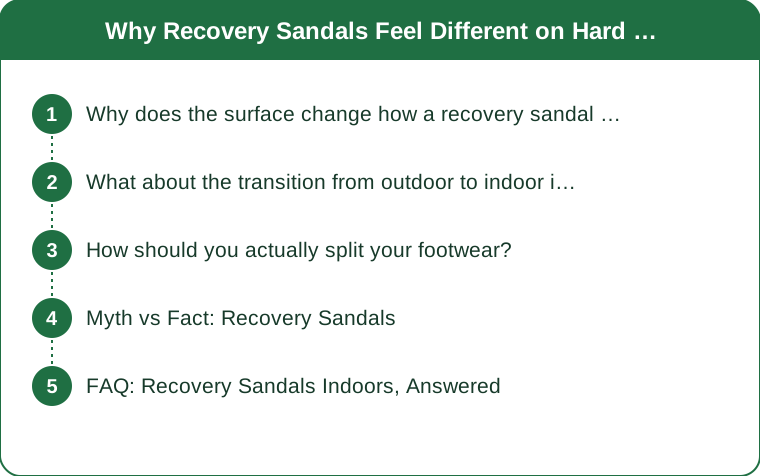
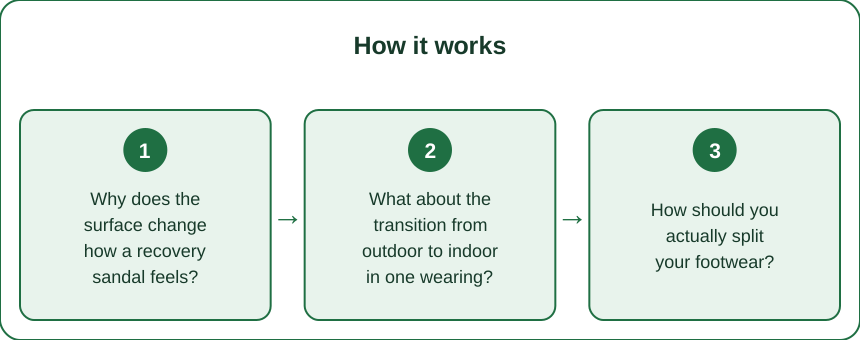
Why does the surface change how a recovery sandal feels?
Three things stack, and they all point the same way.
Cushioning is a system, not a property of the shoe. The total give under your foot is the foam plus the surface. Add soft foam to a surface with some compliance and you get a comfortable total; add the same foam to tile over concrete and the foam is doing all of the work alone - and it bottoms out sooner than it does outside.
Movement changes the load pattern completely. Walking loads each foot briefly and alternately, with the arch and calf cycling through work and rest. Standing loads both feet continuously with no cycling at all. Continuous low-level load on an unsupported arch is the more fatiguing pattern by a wide margin, and it is the pattern indoor use produces.
And soft foam requires more stabilising work when you are static. A compliant surface under a stationary foot means small constant corrections from the ankle and foot muscles. Walking masks this because momentum carries you; standing does not.
Which is why the strongest complaint about recovery sandals is almost always indoor-specific: worn as house slippers for hours of standing at a counter, they produce exactly the aching arches people bought them to avoid. The sandal is not failing - it is being used in the one condition its design is worst suited to.
What about the transition from outdoor to indoor in one wearing?
This is where most of the confusion comes from, because the same pair delivers both experiences within twenty minutes.
The walk home is the ideal use case. Post-training, tired feet, a moderately compliant surface, continuous movement, and a short enough duration that the foam is still in its effective range. This is genuinely what the category was designed around.
Then you arrive home and stand. Cooking, tidying, working at a counter. The load pattern flips from cyclical to static, and the surface loses its give, all while you keep the same footwear on because taking it off is a decision you never consciously make.
Foam also responds to time under load, not just to load. Compression over an extended period leaves the material further into its range and slower to rebound - so hour three genuinely feels different from hour one, with nothing else changed.
And temperature matters more than people expect. EVA and similar foams soften as they warm. A sandal that felt supportive on a cool morning is measurably softer by a warm afternoon, and warmer indoor floors in the evening push the same direction. As the season turns cooler over the next few weeks, the same pair will start feeling firmer - which some people read as the sandal wearing in reverse.
The practical read: the sandal has a window - roughly the first hour or two of moving use - and indoor standing sits outside it.

How should you actually split your footwear?
Two pairs solve almost all of this, and they do not both need to be recovery sandals.
Keep the recovery sandal for the job it does well: immediately post-training, walking to and from the gym, poolside, travel days with lots of walking, and the first hour at home while you are still moving around.
Use something firmer with actual arch structure for indoor standing. A supportive house shoe or a structured slide with a defined footbed. The distinguishing feature is not softness - it is whether the footbed holds a shape under continuous load. A firmer sandal that keeps the arch supported for three hours beats a softer one that flattens out after twenty minutes.
Add a mat where you actually stand. An anti-fatigue mat at the sink or counter changes the surface side of the equation, which is often more effective than changing the footwear and costs less than a second pair.
Rotate rather than wearing one pair all day. Changing footwear mid-day varies the load pattern on your feet, and that variation is itself restorative.
And go barefoot deliberately, in short doses, on non-hard surfaces. Time on a rug or carpet with no footwear at all lets the foot muscles work through their range - useful, in moderate amounts, for exactly the feet that live in cushioned shoes.
One thing to avoid: wearing a well-compressed old pair indoors because it is soft and comfortable. Foam that has lost its rebound provides neither cushioning nor support - it is the worst of both, and it is usually the pair that lives by the door.
Myth vs Fact: Recovery Sandals
Myth: Softer means more recovery. Fact: Recovery from soft footwear comes from reduced peak impact while moving. Under static load, softness increases the stabilising work your foot has to do - which is the opposite of recovery. The right firmness depends entirely on whether you are walking or standing.
Myth: They are a substitute for supportive shoes. Fact: Most recovery sandals offer cushioning with modest structural support. They are a complement to supportive footwear for short periods, not a replacement for it across a working day.
Myth: If they hurt, you need to break them in. Fact: Foam sandals do not break in the way leather does - they compress and lose support over time, which is the opposite of improving. If a new pair hurts in the first hour, the shape is wrong for your foot and time will not fix it.
Myth: The arch bump should feel pronounced. Fact: A contoured footbed should feel like contact along the arch, not a distinct pressure point. A bump you are conscious of is usually in the wrong position for your foot length.
Myth: They last as long as they look intact. Fact: The foam loses rebound long before the sandal looks worn. A pair that still looks new can be functionally finished after several months of near-daily use - and the giveaway is that the sole stops springing back when you press it with a thumb.
The one that surprises people: wearing them for the entire day is the single most common reason people conclude recovery sandals do not work. The dose is the point - a couple of hours does what eight hours undoes.
FAQ: Recovery Sandals Indoors, Answered
Why do my feet ache when I wear recovery sandals at home?
Because hard indoor floors add no give of their own, and standing still loads your feet continuously rather than cyclically. Soft foam under a static foot increases stabilising work rather than reducing it.
How long should I wear recovery sandals for?
Roughly one to two hours of moving use is where most people get the benefit. Beyond that, foam compression and continuous load start working against you.
Are firmer sandals better for indoors?
Generally yes. For indoor standing, a footbed that holds its shape under continuous load matters more than cushioning depth. Softness helps while walking; structure helps while standing.
Do recovery sandals wear out even if they look fine?
Yes. Foam loses rebound well before the sandal looks worn. Press the sole with a thumb - if it stays compressed rather than springing back, the useful life is over.
Will an anti-fatigue mat help more than new sandals?
Often, if the problem is standing in one place. Changing the surface addresses the same variable as changing the footwear and usually costs less.
Do they feel different in cooler weather?
Yes - foam firms up as temperature drops, so the same pair reads as more supportive in autumn than it did in August. That is the material changing, not your feet.
TL;DR:
- Cushioning is foam plus surface - hard indoor floors give none of their own, so the foam does all the work and bottoms out sooner.
- Standing still is harder on a soft base than walking on it, because static load removes the work-rest cycling your foot relies on.
- Foam also softens with warmth and compresses over time, so hour three genuinely feels different from hour one.
- Use recovery sandals for their real job: post-training, walking, travel - roughly one to two hours of moving use.
- For indoor standing, choose structure over softness, and add an anti-fatigue mat where you actually stand.
- Rotate footwear through the day rather than wearing one pair from morning to night.
- The old compressed pair by the door is the worst possible indoor option - no cushioning and no support.
The sandal is not underperforming. It is being asked to do the one job it is worst at.
Keep Reading
This article is for general informational and styling purposes only. Fit, sizing, and product availability may vary.