Why Recovery Sandals Feel Great for Twenty Minutes, Then Your Arches Ache
Quick Answer: Recovery sandals combine a soft, thick midsole with a pronounced arch contour, and that combination reduces the work your foot muscles normally do. That is exactly what feels good immediately after training and exactly what causes aching after a few hours, because the arch is held in one position and the small stabilizing muscles are both unloaded and statically supported. Wear them for one to three hours post-training, not all day, and alternate with flatter shoes.
The first twenty minutes after a hard run, they are the best thing you own. Three hours later your arches feel oddly tired despite having done nothing. Both reactions come from the same design choice.

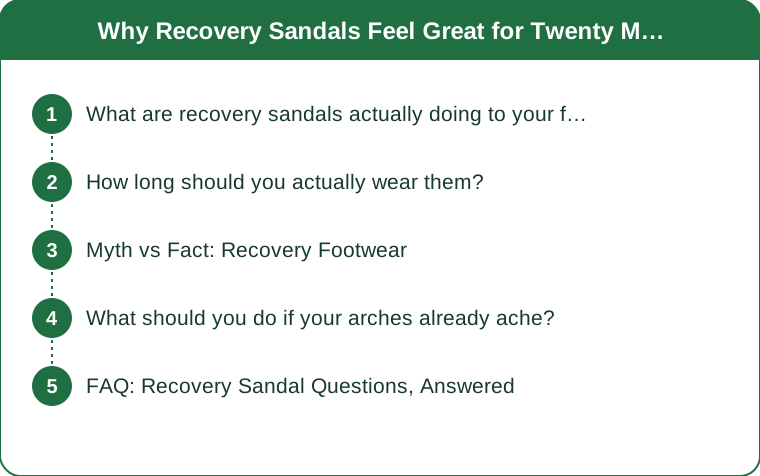
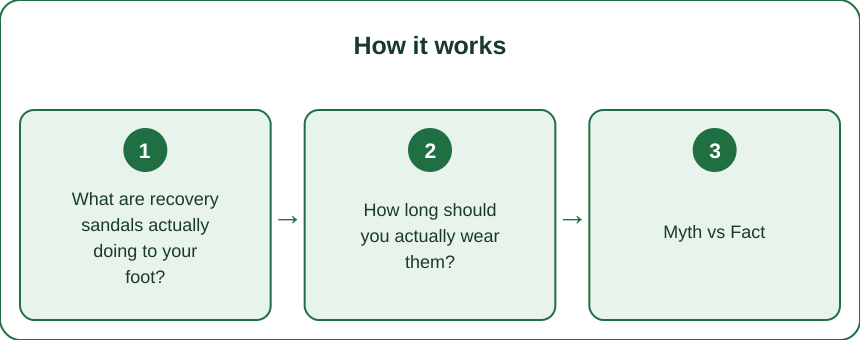
What are recovery sandals actually doing to your foot?
Two things simultaneously, and they pull in opposite directions over time.
They reduce impact loading. A thick, soft midsole absorbs a share of ground reaction force. Immediately after a long run, when tissue is fatigued and sensitive, that reduction feels dramatic and genuinely helps comfort.
They hold the arch in a fixed contoured position. Most recovery sandals have a molded footbed with a defined arch shape. That shape supports the arch passively, which means the tibialis posterior, the intrinsic foot muscles, and the plantar fascia do less of their normal work.
Short term, that unloading is the point. Fatigued tissue benefits from a period of reduced demand.
Longer term, two problems emerge. First, holding a joint in one fixed position for hours produces static loading, and static positions fatigue tissue differently from varied movement. The foot is designed to change shape constantly through a step cycle, and a rigid contour prevents that.
Second, consistently unloading a muscle group reduces its capacity over time. This is the same principle as any other tissue: reduced demand leads to reduced capacity, which then makes unsupported walking feel worse, which encourages more sandal use.
Neither of these makes recovery sandals a bad product. They make it a tool with a dose.
How long should you actually wear them?
A reasonable framework, and it is about timing more than total hours.
Immediately post-training, one to three hours. This is the window where the impact reduction is most useful, because tissue is most sensitive and you are least interested in your feet working hard.
Around the house in the evening, fine. Walking short distances on hard indoor floors is where cushioning does obvious good and where the total time is naturally limited.
All-day wear, no. Eight hours in a fixed arch contour is where the aching comes from, and it is also where the capacity loss happens if it becomes the daily default.
Long walks and errands, no. These sandals are not designed for distance. Most have minimal heel retention, which means your toes grip to keep them on, and that gripping is a significant and unfamiliar demand on the foot flexors. Toe-gripping fatigue is a large share of what people interpret as arch pain from recovery sandals.
The practical alternation that works well: recovery sandals for the first few hours after training, a flatter and more flexible shoe for general wear, and barefoot time at home when your feet are not sore. That rotation gives the foot both the recovery and the varied demand it needs.

Myth vs Fact: Recovery Footwear
Myth: More cushioning is always better for recovery. Fact: cushioning helps with impact-related soreness and does nothing for muscular fatigue, which is most of what you feel after a hard session. Beyond a point, additional softness reduces stability and increases the work the foot does to stay balanced.
Myth: The arch support strengthens your arch. Fact: support substitutes for the arch’s own function. It relieves symptoms in the short term, which is valuable, and it does not build capacity. Arch strength comes from loading the foot, not from supporting it.
Myth: If they hurt, you got the wrong size. Fact: size can be a factor, but the more common cause is duration and the toe-gripping that comes from a backless design. Try shorter wear before trying a different size.
Myth: They replace the need for proper footwear. Fact: they are a specific-purpose item, roughly equivalent to a compression garment. Useful in a window, not a substitute for shoes that fit and support walking.
Myth: Recovery sandals prevent injury. Fact: there is little evidence for that claim. They improve comfort after training, which has real value for adherence and for how you feel, but comfort and injury prevention are separate questions.
The one that reframes the purchase: the strap configuration matters more than the midsole for most people’s comfort. A slide with a single wide strap requires no toe grip if it fits well; a thong style requires the toes to hold the sandal, which fatigues the foot flexors over hours. If your arches ache after wearing them, try a different strap style before concluding the cushioning is the problem.
What should you do if your arches already ache?
A short sequence, in order.
Reduce wear time first. Cut to one hour immediately post-training for a week and see whether the ache resolves. This alone answers the question for most people.
Add flat, flexible time. Walking barefoot on soft surfaces at home for a few minutes daily gives the foot varied demand. Start with short durations if you are not used to it.
Do direct foot strengthening. Short foot exercises, toe spreading, calf raises with a slow lowering phase, and towel scrunches all build the tissue that has been unloaded. Five minutes, three times a week, is enough to make a difference within a month.
Check the sandal’s age. Recovery sandal foam compresses with use and loses both its cushioning and its arch contour, often well before the sandal looks worn. A sandal past its useful life provides an inconsistent surface that the foot works harder on.
Consider whether the ache is actually from training. Increased mileage, new shoes, or a change in surface all produce arch symptoms, and the sandals may be the thing you noticed rather than the cause.
This is general information, not medical advice. Arch or heel pain that is worst with the first steps in the morning, persists beyond a couple of weeks, or is sharp rather than achy is worth having assessed by a professional, as those patterns can indicate plantar fasciitis or other conditions that benefit from proper evaluation.
FAQ: Recovery Sandal Questions, Answered
Can I wear them for travel days?
Short airport walks, yes. Long travel days with significant walking, no, because backless designs demand toe gripping over distance. A cushioned shoe with a proper heel counter is a better travel choice.
How do I know when to replace them?
When the footbed shows a visible impression of your foot that does not spring back, when the arch contour feels flatter than it did, or generally after a year of regular use. Compressed foam is the failure mode, not visible wear on the outsole.
Are they worth it at all?
For most people who train regularly, yes, as a comfort tool in the hours right after a hard session. Treat the price as buying a comfortable few hours rather than a recovery intervention, and the value proposition is easy to judge for yourself.
TL;DR:
- Recovery sandals reduce impact and hold the arch in a fixed contour, which unloads the foot muscles
- That unloading feels excellent for one to three hours and causes static fatigue over a full day
- Backless and thong designs make the toes grip to hold the sandal on, which is a large part of the ache
- Alternate with flat, flexible footwear and add five minutes of foot strengthening three times a week
Cap them at three hours after your next hard session and see if the evening ache disappears. It usually does.
Keep Reading
This article is for general informational and styling purposes only. Fit, sizing, and product availability may vary.