Why Recovery Sandals Often Feel Worse in the First Week
Quick Answer: Recovery sandals typically have a pronounced arch contour and a different heel drop than everyday shoes. That redistributes load across the foot to areas that haven’t been carrying it, producing an adjustment period that commonly lasts one to two weeks and gets misread as the sandals not working.
You bought them for tired feet. Now your arches ache in a completely new place and you’re wondering whether you wasted the money. Probably not — but the first week is genuinely the worst week.

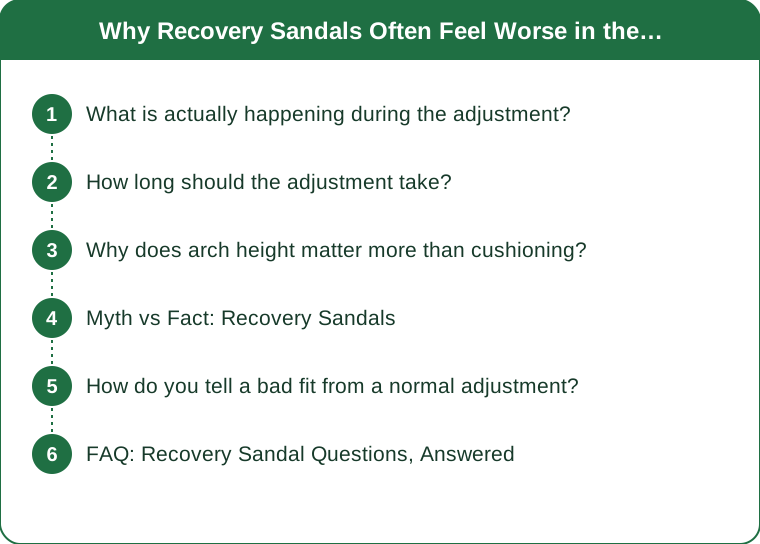
What is actually happening during the adjustment?
A contoured footbed changes where pressure is distributed. Areas that carried less load in flat shoes — the arch itself, the medial midfoot — now carry more, and the muscles and connective tissue there aren’t conditioned for it.
This is a load redistribution, not a break-in. The material barely changes; what changes is your tissue’s tolerance for the new distribution. That distinction matters, because break-in implies waiting while adaptation implies gradually increasing exposure — and only one of those is a plan.
How long should the adjustment take?
Commonly one to two weeks with gradual wear. The standard approach is to start at an hour or two a day and increase from there rather than wearing them all day immediately.
A useful boundary: mild novel aching that fades within an hour of taking them off is adjustment. Sharp pain, pain that persists after removal, or pain that worsens across days is not. The second category is a reason to stop and reconsider the model, not to push through — arch height is a fit variable and a footbed that doesn’t match your arch won’t become right with time.
Why does arch height matter more than cushioning?
Because cushioning affects impact absorption while arch contour affects position. Two sandals with identical foam can feel completely different depending on how high and how far forward the arch sits.
A high-arch contour under a low-arch foot creates a pressure point rather than support, and no amount of soft foam fixes a shape mismatch. This is why recovery sandal reviews are so wildly inconsistent — people with different foot structures are describing genuinely different experiences of the same product.

Myth vs Fact: Recovery Sandals
Myth: More cushioning means better recovery. Fact: Very soft foam can increase instability, which makes some feet work harder rather than less. Support geometry matters more than softness.
Myth: Recovery sandals strengthen your feet. Fact: They generally do the opposite by supporting the arch. That’s fine for their purpose — post-exercise comfort — but they’re not a foot-strengthening tool.
Myth: They’re only useful right after a workout. Fact: Most of their value is in the general hours of standing and walking around the house, not the twenty minutes after a run.
Myth: They last until they look worn. Fact: The foam compresses and loses rebound long before the outsole looks used. Support declines invisibly over months.
How do you tell a bad fit from a normal adjustment?
Three questions, and they’re pretty clean. Where is the discomfort? Arch and midfoot aching is typical adjustment. Pain at the heel, under the ball of the foot, or between toes usually signals a shape mismatch.
Does it resolve after removal? Adjustment discomfort fades within an hour or so. Persistent pain doesn’t.
Is it improving week over week? Adjustment gets better. A mismatch stays the same or worsens no matter how gradually you increase wear. If the answer to the third question is no by the end of week two, the model is wrong for your foot and more patience won’t change it.
FAQ: Recovery Sandal Questions, Answered
Can I wear them all day?
After the adjustment period, many people do. They’re built for comfort rather than for extended walking, so long-distance walking is usually better served by shoes.
How often do they need replacing?
Foam compresses with use. Most manufacturers suggest replacement somewhere in the range of a year for regular wear, and the loss of rebound is the signal, not the appearance.
Are they appropriate for plantar fasciitis?
Some people find arch support helpful, but plantar fasciitis has multiple causes and management varies. This is general information, not medical advice — persistent heel pain warrants a clinician’s assessment.
TL;DR:
- Contoured footbeds redistribute load to under-conditioned areas of the foot
- The first week is an adaptation period, not a break-in of the material
- Start at an hour or two a day and build up gradually
- Arch shape matters more than cushioning softness, and mismatches don’t resolve with time
- Discomfort that persists after removal or doesn’t improve by week two means wrong model
Give them two weeks of graduated wear before judging. If it’s still worse at the end of that, it’s the shape, and no amount of patience fixes a shape.
Keep Reading
This article is for general informational and styling purposes only. Fit, sizing, and product availability may vary.