Why Recovery Sandals Lose Their Support Months Before They Look Worn Out
Quick Answer: The foam in recovery sandals compresses and loses its rebound properties through repeated use well before the outer material shows visible wear, so a pair can look fine while providing significantly less arch and heel support than it did when new — usually somewhere around 300-500 hours of wear.
Because the outside holds up so well, it’s easy to keep wearing a pair long after the actual recovery benefit has faded.
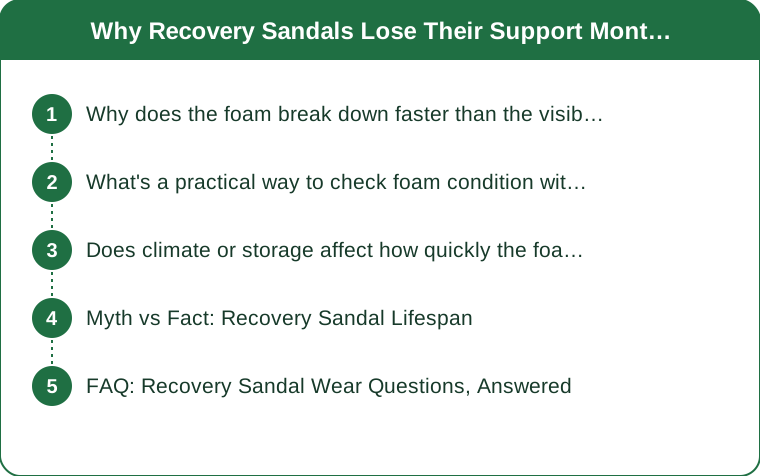
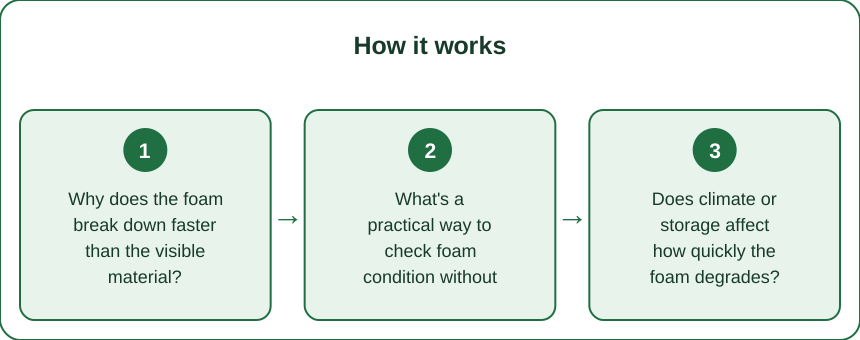
Why does the foam break down faster than the visible material?
The compression foam that provides support experiences repeated loading and unloading with every step, and over hundreds of hours this causes the cell structure to gradually lose its ability to rebound to its original shape — a process invisible from the outside since the outer strap and sole material are far more durable than the internal foam. This mismatch is exactly why looks are a poor indicator of when to replace them.
What’s a practical way to check foam condition without special equipment?
Pressing your thumb firmly into the footbed and timing how quickly it springs back compared to a memory of how a new pair felt is a rough but useful test — foam that stays compressed for a noticeably longer moment, or barely rebounds at all, has lost meaningful support capacity. Comparing side by side with a friend’s newer pair of the same model, if possible, makes this easier to judge accurately.
Does climate or storage affect how quickly the foam degrades?
Yes — consistent heat exposure (like leaving sandals in a hot car) accelerates foam breakdown significantly compared to sandals stored at room temperature, since heat speeds up the cell degradation process in most foam types used in recovery footwear. Rotating sandals out of direct sun and heat when not in use meaningfully extends their functional lifespan.
Myth vs Fact: Recovery Sandal Lifespan
Myth: If the straps and sole look intact, the sandals are still doing their job. Fact: Outer material durability has little correlation with how much support the internal foam still provides.
Myth: Recovery sandals last indefinitely since they’re not running shoes. Fact: The compression foam that provides recovery benefit has its own wear timeline, typically shorter than the outer material’s lifespan.
Myth: More expensive recovery sandals never lose support. Fact: All compression foam degrades with use regardless of price point — quality affects the rate, not whether it happens.
FAQ: Recovery Sandal Wear Questions, Answered
How many hours of wear typically signal it’s time to replace them?
Most recovery sandal foams show meaningful support loss somewhere in the 300-500 hour range, though this varies by brand and foam type.
Is there a visible sign at all that support has faded, even if subtle?
A slightly flattened, less springy footbed profile compared to new can sometimes be seen if you look closely at the arch area, even before it’s dramatically obvious.
Does wearing recovery sandals for walking instead of just post-workout recovery wear them out faster?
Yes — more total wear time, regardless of activity type, accelerates foam compression, so all-day wear shortens the functional lifespan faster than occasional post-workout use.
TL;DR:
- Recovery sandal foam degrades through repeated compression well before the outer material shows wear
- A simple thumb-press rebound test can help gauge remaining support compared to when they were new
- Heat exposure, like leaving sandals in a hot car, accelerates foam breakdown
- Expect meaningful support loss somewhere around 300-500 hours of wear, regardless of how they look
If your recovery sandals still look new but don’t feel as supportive as they used to, trust that feeling — the foam usually gives out long before the appearance does.
Keep Reading
This article is for general informational and styling purposes only. Fit, sizing, and product availability may vary.