Why Recovery Sandals Are Brilliant for Some Feet and Awful for Others
Quick Answer: Recovery sandals impose a fixed arch shape and a fixed amount of cushioning on every foot that wears them. If that built-in shape roughly matches your arch, they feel excellent. If your arch is higher or lower than the mould, the sandal either presses into it or leaves it unsupported, and hours of wear produces ache rather than recovery. Check your arch height first, and treat them as a short-duration post-exercise tool rather than all-day footwear.
The reviews for any recovery sandal are always split, and the split is not about quality.
This blog has covered why recovery sandals feel great for twenty minutes and then your arches ache, and why they help after rather than during. This is the reason the same product produces opposite experiences.

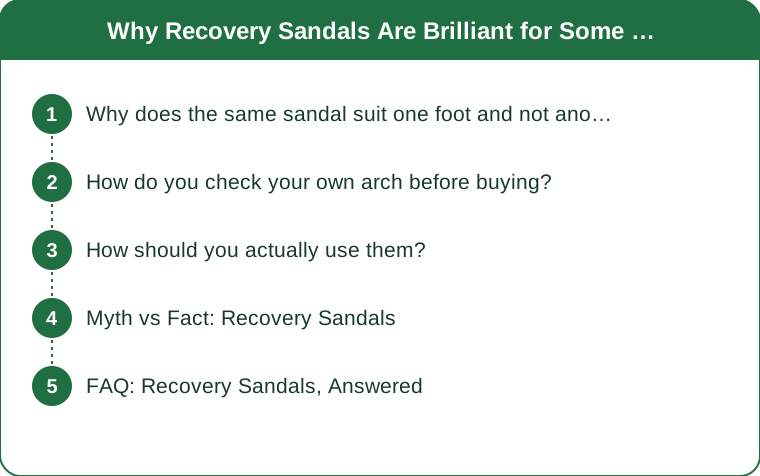
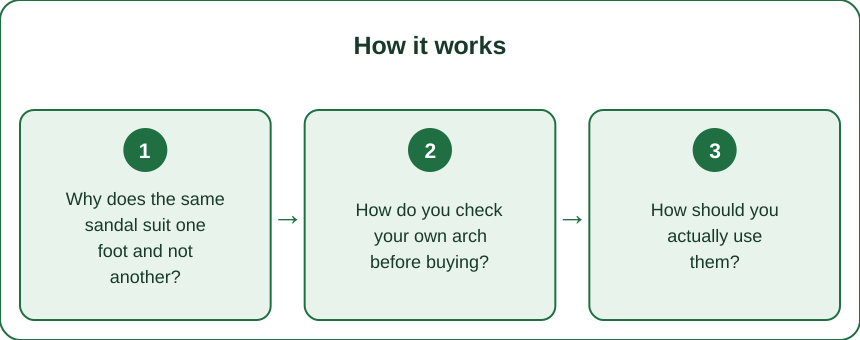
Why does the same sandal suit one foot and not another?
Because it is a single fixed shape being applied to a highly variable body part.
Recovery sandals are moulded with a built-in arch profile. That profile is designed around an average, and arch height varies enormously between people, considerably more than shoe size does.
A high arch on a moderate footbed leaves a gap. The arch is unsupported, your foot collapses slightly further than usual into the soft foam, and the muscles supporting the arch work continuously to compensate.
A low or flat arch on a pronounced footbed gets pressed into. The moulded ridge pushes up into an arch that does not have room for it, which produces a specific ache along the inside of the foot after an hour or two.
Softness makes both problems worse, not better. Very soft foam lets the foot sink and shift, so the arch shape is applied inconsistently and your foot muscles work continuously to stabilise. This is the paradox: the plushest sandal is often the one that produces the most fatigue.
There is no adjustment available. Unlike shoes, most recovery sandals have no strap tension, no insole, and no way to modify the fit. What you get out of the box is what you have.
And the mismatch is invisible in a shop. Thirty seconds of standing in them tells you almost nothing, because the problem takes an hour or two of wear to appear. This is why so many people buy them, love them briefly, and then quietly stop wearing them.
How do you check your own arch before buying?
Two tests, both of which take under a minute.
The wet footprint test. Wet the sole of your foot and step onto a piece of cardboard or a dry paving slab. A print showing most of the foot indicates a low arch. A print showing a narrow band or a break between heel and ball indicates a high arch. A print showing roughly half the midfoot is a moderate arch, which is what most recovery sandals are built for.
The finger test. Stand normally and try to slide a finger under the highest point of your arch. If it slides in easily with room to spare, your arch is high. If it will not fit at all, your arch is low. Some resistance is moderate.
Then match the sandal:
- Moderate arch: most standard recovery sandals will suit you, and this is why they have such enthusiastic advocates.
- High arch: look for a deeper, more pronounced contour rather than a flatter one, and expect to try more than one brand.
- Low or flat arch: choose a flatter footbed with firmer foam. A pronounced arch ridge will press into you.
Firmness matters as much as shape. A firmer footbed supports your foot in the intended position; a very soft one lets it move and requires your muscles to hold you. For anything longer than half an hour, firmer is generally better.
Test them for at least an hour at home before committing. Wear them on carpet, keep the box, and pay attention at the 60 to 90 minute mark, which is when a mismatch becomes obvious.
And if you have plantar fasciitis, diabetes, or any diagnosed foot condition, footwear choice is a conversation for a podiatrist rather than a review section. This is general information, not medical advice.

How should you actually use them?
As a targeted short-duration tool, not as general footwear.
Wear them after exercise, not during and not all day. Thirty to ninety minutes after a session, while your feet are warm and swollen, is exactly the window where the cushioning is most welcome.
Take them off before your feet start to ache. The ache is the signal that your foot muscles have been working to stabilise on soft foam for too long. Once you know your personal limit, set it as a rule rather than waiting for the signal each time.
Do not wear them for long walks or standing. They are designed for low-demand recovery periods, not for movement. A long walk in soft unsupported sandals is a common source of the very ache people bought them to avoid.
Alternate with going barefoot on a firm floor. Your feet also benefit from doing their own work, and permanent cushioning is not a recovery strategy. Barefoot time on a firm surface is genuinely useful for foot strength.
Expect a break-in period of poor comfort. Most recovery sandals feel firmer and stranger for the first week as the foam adapts. Week one is not a fair test, which this blog has covered separately.
And replace them before they look worn. The foam loses its support properties long before the sandal looks old. If they feel noticeably flatter than when new, they have stopped doing the job even if they look fine.
Myth vs Fact: Recovery Sandals
Myth: More cushioning means better recovery. Fact: Past a point, extra softness means your foot muscles work harder to stabilise. Firmer footbeds are often better for longer wear, and the plushest option is frequently the most fatiguing.
Myth: They actively speed up recovery. Fact: They reduce discomfort and pressure on tired feet, which is genuinely valuable and is not the same as accelerating tissue repair. Sleep, food, and time do the recovering.
Myth: If they hurt, you need to break them in longer. Fact: A week of adjustment is normal. Arch pain that persists past two weeks is a shape mismatch, and more wearing will not resolve it.
Myth: Size up for comfort. Fact: An oversized recovery sandal puts the moulded arch in the wrong place relative to your foot, which is the exact problem you are trying to avoid. Correct length matters more here than in most footwear.
Myth: They are fine for all-day wear. Fact: They are designed for short recovery periods. All-day wear in soft unsupported footwear is a common cause of foot fatigue, and it is the most frequent misuse of the category.
Myth: Expensive ones are better. Fact: Fit to your arch matters far more than price. A cheap sandal that matches your arch shape will outperform an expensive one that does not, every time.
FAQ: Recovery Sandals, Answered
Why do recovery sandals hurt my arches?
Usually a mismatch between the sandal’s moulded arch and your own. A high arch is left unsupported and a low arch is pressed into. Check your arch with the wet footprint test before buying.
How long should I wear recovery sandals?
Thirty to ninety minutes after exercise. They are a short-duration tool for tired feet, not all-day footwear, and long wear in soft unsupported foam causes the fatigue people are trying to avoid.
Are recovery sandals worth it?
For a moderate arch, often yes, for post-exercise comfort. For high or flat arches, only with a model matched to that shape. They reduce discomfort rather than accelerating recovery.
TL;DR:
- Recovery sandals apply one fixed arch shape to feet that vary enormously, which is why reviews split so sharply.
- Check your arch with the wet footprint test or the finger test before buying, and match the footbed contour to it.
- Firmer is usually better than softer for anything longer than half an hour.
- Wear them 30 to 90 minutes after exercise, not all day and not for long walks.
If they ache after 90 minutes, that is a shape mismatch, not a break-in period. Two weeks is the limit before you accept it.
Keep Reading
This article is for general informational and styling purposes only. Fit, sizing, and product availability may vary.